

Zomato CEO explores brain health wearable company based on Gravity Aging Hypothesis - tracking cerebral blood flow to combat aging
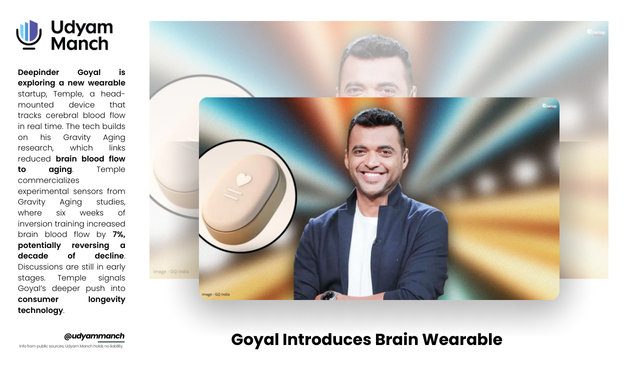
• Deepinder Goyal is reportedly looking to introduce Temple, a new wearable device brand centered on measuring cerebral blood flow.
• Daily inversion exercises for six weeks were shown to increase cerebral blood flow by 7%, possibly counteracting up to 10 years of age-related deterioration.
• Temple turns the experimental head-mounted technology from Continue Research’s Gravity Aging studies into a consumer-ready product.
• Deepinder Goyal is exploring a new venture called Temple Wearable, a device company that could signal the next chapter in his pursuit of longevity science. The Eternal founder has been spotted testing a discreet head-mounted gadget capable of measuring cerebral blood flow in real time. Although still in early development, Temple is positioned as a wearable sensor focused on monitoring brain blood flow. The effort closely aligns with Goyal’s Gravity Aging Hypothesis, which argues that reduced cerebral perfusion accelerates the aging process.
While still early in development, Temple is expected to center around health-monitoring wearables, with no final decisions made yet. Its placeholder website hints at its direction with a cryptic statement: “The future of health starts where no one’s looking. Inside your brain.”
Goyal noted that the need for precise, continuous monitoring of brain blood flow emerged during his work on the Gravity Aging Hypothesis, and he has been personally using the device for about a year. The experimental sensor rests above his right eyebrow and measures cerebral blood flow in real time.
The hypothesis focuses on Cerebral Blood Flow (CBF), proposing that when a person stands or sits upright, gravity pulls blood downward, reducing CBF by as much as 17%. Over many years, this chronic underperfusion may weaken the hypothalamus and brainstem.
According to Goyal, early research by his team showed that using an inversion table daily for more than 10 minutes over a six-week period increased average brain blood flow by 7 percent. He suggests this gain could offset roughly a decade’s worth of age-related decline in cerebral blood flow.
Continue Research also reviewed decades of scientific literature and found that nearly every well-established healthy habit—such as walking, exercise, weight training, quality sleep, hydration, and eating leafy greens—boosts blood flow to the brain.
Goyal emphasized that brain blood flow is already recognized as a key indicator of aging, longevity, and cognitive function, making the device valuable even if his hypothesis is eventually disproven. Unlike fitness trackers that measure steps or heart rate, Temple is dedicated solely to monitoring cerebral blood flow as its primary physiological metric.
Goyal emphasized that Temple will likely remain a small, specialized venture, separate from Eternal, his larger project. He also clarified that the hypothesis was not crafted as a marketing strategy, stressing his commitment to scientific integrity over commercial interests.
The news has stirred significant debate across both social media platforms and medical forums.One LinkedIn user applauded the idea as “a breakthrough in health wearables, enabling continuous tracking of brain blood flow, a biomarker potentially connected to aging and cognitive function.”In contrast, several doctors voiced strong objections—one labeling it “pure pseudo science” and cautioning that inversion techniques may pose risks. Much of the criticism focuses on cerebral autoregulation, the brain’s natural system for keeping blood flow stable.
Another researcher noted that “several prominent scientists have responded positively, describing the hypothesis as intriguing and potentially significant for human longevity,” while still stressing the need for peer-reviewed validation.